What to Check
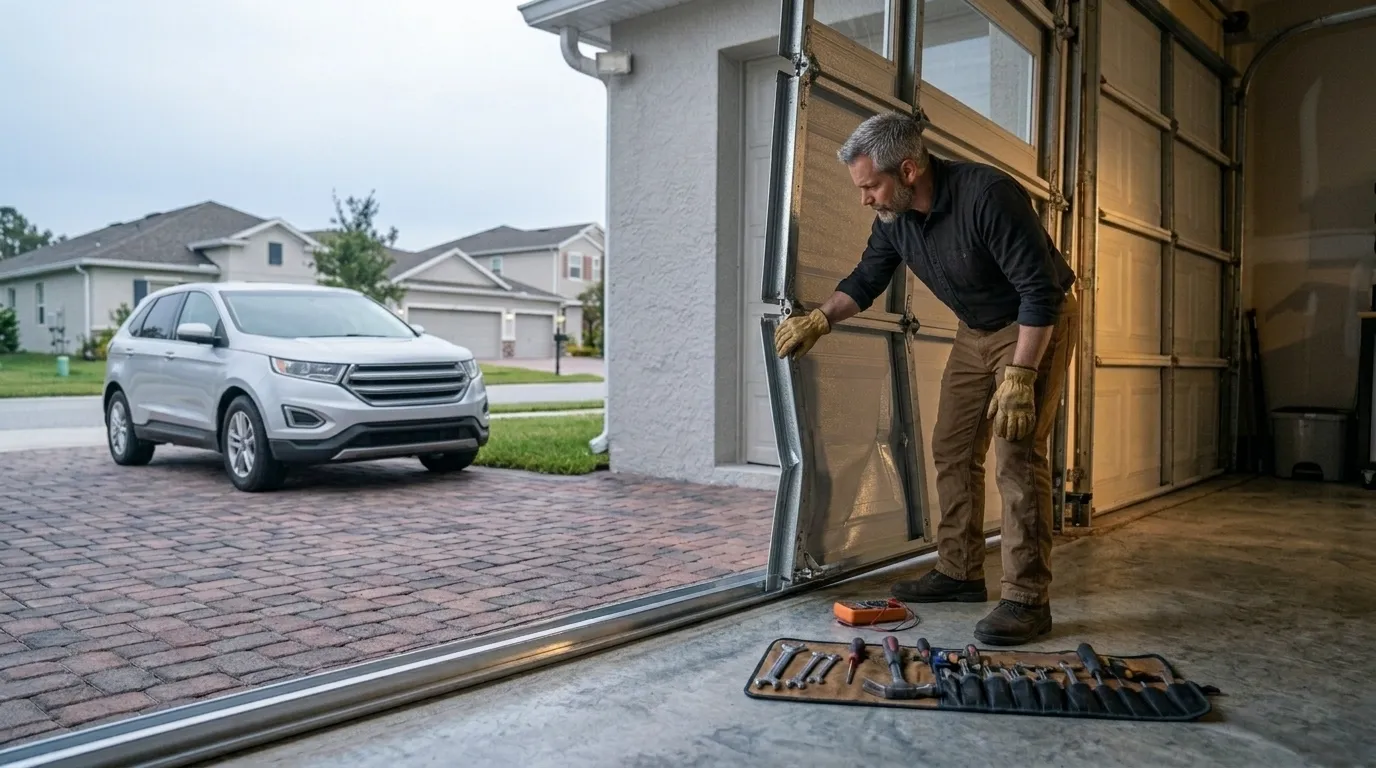
Start with the door's build era. Housing across this service area went up mostly between 1953 and 2005, with the bulk of it dating to the 1960s and '70s across the 32 named areas we work in, from Victoria Park to Melrose Manors. If your door is original to a house from that window, it's almost certainly a single layer of steel or aluminum with no foam core behind it. Put your hand flat on the inside panel on a warm afternoon. If it's hot to the touch and the garage feels like an oven compared to the rest of the house, that's your answer.
Check the weatherstripping at the bottom and sides next. On doors this old, it's usually the original rubber, cracked and shrunk, or a cheap replacement that doesn't seat right against the track. Also look at the panel seams for rust streaks or bubbling paint, especially near the bottom two feet. That's where moisture sits longest. None of this tells you the door is broken, but it tells you whether you're dealing with a door that was never built to hold a temperature or a seal in the first place.
What Local Conditions Do
Fort Lauderdale sits in a mild temperate band, not a place with hard freezes or deep cold snaps, so nobody built garage doors here to stop heat loss the way you'd see up north. That's the trade-off: the climate never punished uninsulated steel the way winter does elsewhere, so it never got fixed. What it does instead is push heat and humidity straight through an uninsulated panel into the garage, and often into whatever room sits behind it.
A single-skin steel door heats up fast in direct sun and holds that heat into the evening. Combine that with the humidity typical of this area and you get condensation forming on the inside of the door itself, especially overnight when the metal cools faster than the air around it. Over years, that's what causes the rust bubbling at the bottom panel edges on so many of these older doors. It's not a manufacturing defect. It's exactly what an uninsulated steel door does in this kind of air, year after year, with nothing in the code at the time requiring otherwise.
The Problem
The core issue is timing. Insulation requirements for garage doors came along well after most of the housing stock in this area was built, and a door installed any time from 1953 into the 2000s was made to a standard that didn't ask for a thermal break, a foam core, or a vapor barrier. It was just a steel or aluminum shell hung on hardware, built to open and close and keep rain out. That was the whole job.
So when a homeowner in one of the older pockets near Wilton Manors or Lauderdale Manors asks why their garage runs ten degrees hotter than the house, the honest answer usually isn't a broken part. It's a door doing exactly what it was built to do, in a climate and on a house that predate the idea of insulating it at all. Replacing it with a modern insulated door solves that. Patching or repairing the existing panel does not, and we won't tell you otherwise just to book the smaller job.